


Why all babies need burped — breast or bottle fed

There are a multitude of beliefs that have transpired over my 30+ year career in the postnatal field that quite frankly, need to be thrown out the window and never spoken again, for the benefit of our newborns.
Some of these beliefs have been birthed out of best intentions, perhaps delivered before we truly knew.
Some birthed and pushed as the status quo, to make a profit from the ill health that they create for our little ones.
And this filtered belief that breastfeeding babies in particular don't need to burp, but bottle-fed babies most certainly do, is certainly one of the former. But thankfully, this has now been proven to be a myth because we now have the biology and the technology that clearly refutes it. Now, we just need to filter that truth to you, the parents.
Because what many parents aren't being told is that swallowing air is not just normal for newborns, it is actually expected, and the evidence for this comes from perhaps a surprising place – but first let’s start with the basics.
Your baby is designed to swallow air
Despite what you may have heard, every baby swallows air during feeding, and not only is this is completely normal, it's a gift of nature that advances development for all humans from birth through cultivating their Six-Wind-Cues, which are fundamental to their existence in their new world. So, not only is there an innate positive reason that our newborns swallow air, there is also a natural design to do so through their remarkable coordination of sucking, swallowing, and breathing.
Research from the University of Western Australia confirms that while healthy breastfeeding babies are able to suck and breathe at the same time, they must briefly pause breathing with every single swallow. This is a normal, protective mechanism that prevents milk from entering the airway1 and it lasts for about half a second, happening with every swallow, throughout every feed. The study then showed that because breathing momentarily stops each time a swallow occurs, small amounts of air are inevitably taken into the stomach, not because anything is wrong, but simply because of the way the human body is designed.
A further, prospective study published in the Pediatric Research confirmed that while breastfeeding produces the most organised and coordinated feeding pattern possible,2 that even this gold-standard feeding pattern cannot eliminate air swallowing entirely, because it is built into the mechanics of how swallowing works.² Additionally, a 2015 study found that air being swallowed is a universal feature of infant feeding.3
So, with this known, I believe we can safely say that all newborns swallow air no matter how they feed, but just in case you are still unconvinced, which is fair enough, perhaps this next evidence will help dissolve that questioning.
Keep reading after the free booklet Three Top Burping Tips advert...
3 Top Burping Tips
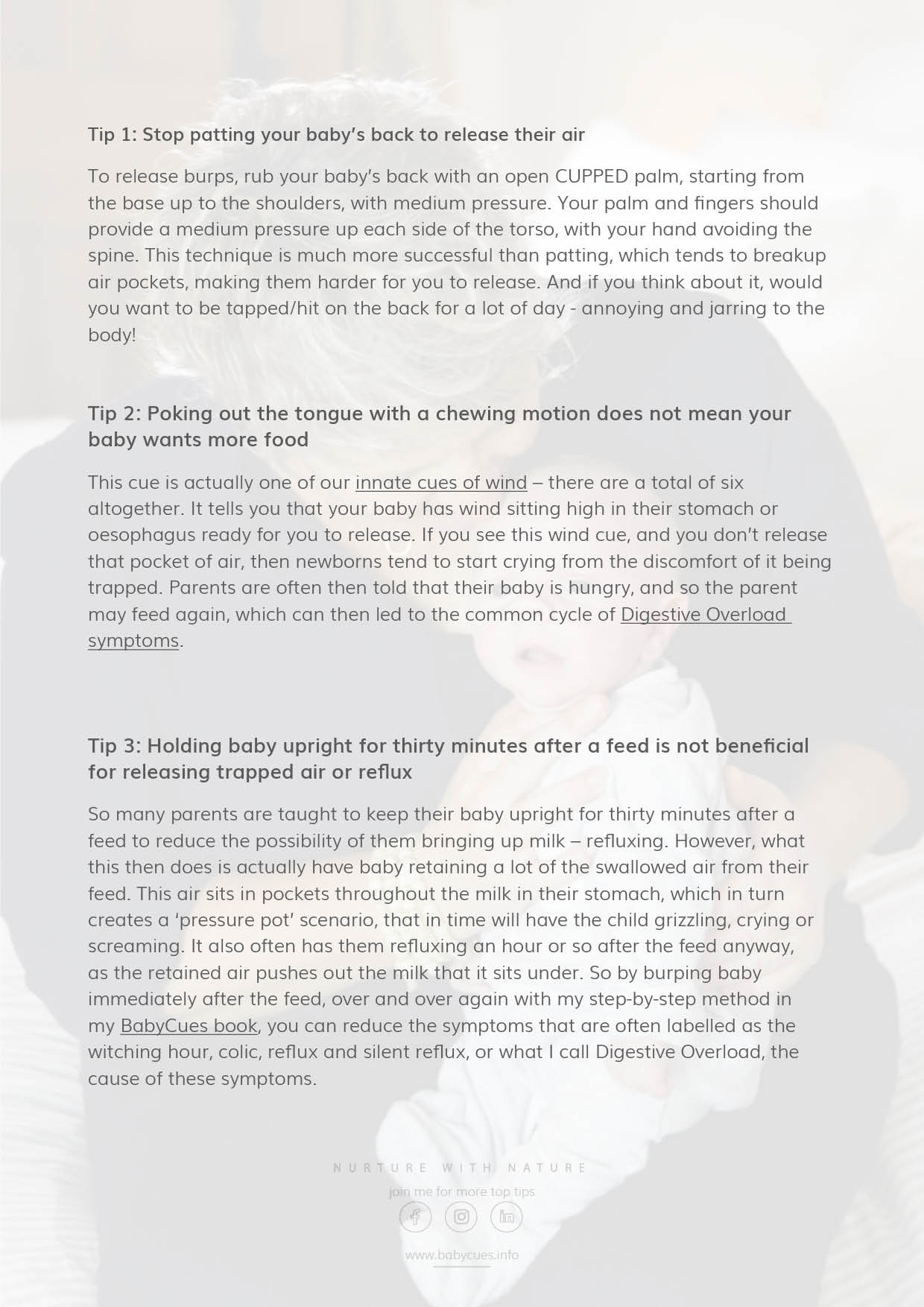
These three top tips may just surprise you for many parents around the world are taught to do these burping practices, but they actually hinder the release of trapped air in the stomach.

- Stimulating air release
- Recognise a wind-cue
- Beneficial positioning
 Submitting data
WHAT'S INSIDE
- Stimulating air release
- Recognise a wind-cue
- Beneficial positioning
Swallowed air a marker of health
The evidence for air swallowing in newborns doesn't stop at feeding research alone. Some of the most compelling proof comes from an unexpected place entirely and that is medical imaging.
Soon after birth, X-rays show that swallowed air is visible in a newborn's duodenum within just one hour of birth, in the small bowel by three hours, throughout the entire small bowel by twelve hours, and reaching the rectum within 24 hours.4 Additionally the clinical guidance from Johns Hopkins University School of Medicine states plainly that a newborn abdomen without trapped air is considered abnormal because it usually means the infant is too unwell to swallow and that there may be a blockage in the digestive tract, or the baby is critically ill.5
So, from the medical perspective, the absence of swallowed air is a problem, not its presence. Although I would like to add, the presence of air can become a problem for our young when it is not managed enough to remain in balance within the digestive system, through learning how to burp your baby well. Especially when 80% of gas found in a newborn’s digestive system comes directly from swallowed air via that mechanism of suck-swallow-breathe mechanism.6
But hasn't science said burping is unnecessary?
You may have come across headlines telling you that science has proven burping is unnecessary, pointing to a single study published in 2014. It is worth looking at what that study actually found.
Conducted in India with just 71 mother-baby pairs, it measured two specific outcomes: colic episodes and spitting up. It found no difference in colic between burped and non-burped babies and found that burped babies spat up more.7 This finding has since been widely used to suggest burping is pointless. But consider this: the air in a burped baby's stomach had to go somewhere. In babies who were burped, it came up, bringing a little milk with it. In babies who were not burped, that same air continued its journey through the digestive system. However, the study did not measure what happened next: the arching, the leg drawing, the distended stomach, the unsettled sleep, the frothy stools. It also did not account for how much babies were carried or how they were fed, or their feeding position.8
Additionally, it is the only study of its kind ever conducted9 and I believe it's quite a significant leap to draw the conclusion that no baby needs burping from a single study of 71 babies that measured just two outcomes. It is also worth noting that the study's own authors did not make that claim. Their measured conclusion was simply that burping did not significantly lower colic events in their sample. That is a very different statement from "burping is unnecessary."7 and yet despite all this, this study is widely quoted as "the study" that proves breastfed newborns don't need burped - hmmmm.
Air going in, needs to come out
Reducing the amount of air your baby swallows during feeding, and burping your baby often after every feed, will help your baby feel more comfortable.10 A randomised controlled trial found that air accumulation from swallowing is directly linked to symptoms of distension and colic11 and another study also established that accumulated air in the stomach can lead to gastric distension and discomfort,2 And this applies to every baby, at every feed, regardless of whether they are breastfed or bottle-fed because all swallow air during these times.
Let’s look at those symptoms closer, because when a baby is not burped to their optimum level, adverse results, and often avoidable symptoms can continually cycle. These include, but are not limited to:
• Refluxing11
• Pedalling legs12
• Arching backwards12
• Bopping on and off the breast and tugging at the bottle teat
• Gulping during feeding
• Not wanting to lay down for long12
• Increased need to suck from the discomfort, often misread and taught as a hunger cue only — and as a result, overfeeding occurs
• Frothy bowel motions12
• Constipation or explosive bowel motions13
• A copious amount of wind and flatulence11
• Distended stomach11
• Hard stomach11
• Crying and screaming12
• Unsettled sleep
These symptoms can present from the newborn stage through to six months, as this is the period when the digestive system continues to mature and the baby's ability to manage and pass air improves.12
Keep reading after the BabyCues Prevent and Remedy book advert
Get the help you need
Hailed as a game changer, life-saver and a must read from parents and postnatal professionals, this self-help book truly has the answers that NATURALLY prevent and heal the symptoms of colic, reflux, silent reflux, the witching hour and lactose and dairy overload - aka Digestive Overload, the true cause of these symptoms.
- nurture your child's digestive system
- Burp your baby to comfort
- Understand their Six-Wind-Cues
- Calm baby with techniques that work
LEARN HOW TO
- nurture your child's digestive system
- Burp your baby to comfort
- Understand their Six-Wind-Cues
- Calm baby with techniques that work
What this all means
It’s clear really - your baby is designed to swallow air from the very first moment they are born. It is not necessarily a sign that something is wrong with your feeding. It is simply how newborn physiology unfolds.
However, if that air accumulates to a point where it causes symptoms, which happens for so many of our infants today because parents are not being taught how to burp their baby well – defined as 10-25 burps after a feed and are receiving this false message that their baby doesn’t need burped – then this can cause painful, unnatural symptoms.
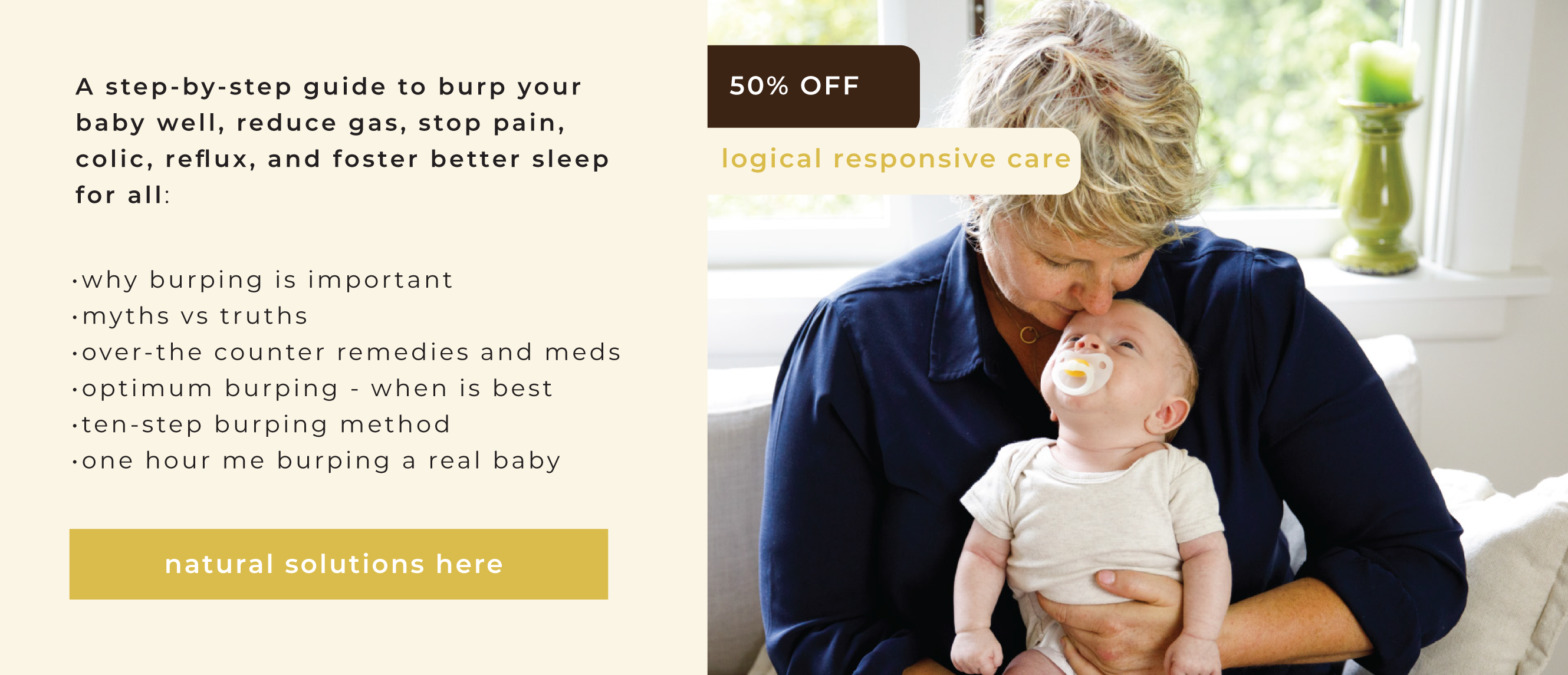
We need to burp our babies after every feed, regardless of whether they are breast or bottle feeding, and learning how to do this is an essential postnatal care practice. That’s why, after spending hours of calming, reducing symptoms through burping and discovering that all newborns are born with Six-Wind-Cues, I have compiled all you need to know in my Burping and Gas Masterclass and knowing how important this is for our babies, this now has 50% OFF.

Do take a look at it because it will have you understanding all possible causes and solutions within the clear, evidenced based theory shared. Plus, you get to watch me using my burping method, called Nature’s Wind Sequence with a real baby, in real time for almost an hour – a life-changing solution for all babies.
1. Geddes, D.T. & Sakalidis, V.S. (2015). Breastfeeding: how do they do it? Infant sucking, swallowing and breathing. Infant, 11(5), 146–150.
2. Goldfield, E.C., Richardson, M.J., Lee, K.G. & Margetts, S. (2006). Coordination of sucking, swallowing, and breathing and oxygen saturation during early infant breast-feeding and bottle-feeding. Pediatric Research, 60(4), 450–455. DOI: 10.1038/sj.pr.6006270
3. Degenaar, H. & Kritzinger, A. (2015). Suck, swallow and breathing coordination in infants with infantile colic. South African Journal of Communication Disorders, 62(1). DOI: 10.4102/sajcd.v62i1.115
4. Gastrointestinal Emergency in Neonates and Infants: A Pictorial Essay. PubMed Central, PMC8743148.
5. Johns Hopkins University School of Medicine (2018). The Pediatric Gastrointestinal Tract: What Every Radiologist Needs to Know. In Diseases of the Abdomen and Pelvis 2018–2021. NCBI Bookshelf.
6. Roentgenological Diagnosis of Alimentary Tract Emergencies in the Newborn. PubMed Central, PMC2747425.
7. Kaur, R., Bharti, B. & Saini, S.K. (2015). A randomized controlled trial of burping for the prevention of colic and regurgitation in healthy infants. Child: Care, Health and Development, 41(1), 52–56. DOI: 10.1111/cch.12166.
8. Do We Really Need to Burp Babies? Here's What the Research Says. The Conversation, 2026.
9. You Don't Need to Burp a Baby. Forge, Medium, 2019. Available at: https://forge.medium.com/you-dont-need-to-burp-a-baby-f9ab1c194d88
10. Colic. Johns Hopkins Medicine.
11. Sucking Behaviour Using Feeding Teats With and Without an Anticolic System: A Randomized Controlled Clinical Trial. PubMed Central, PMC5857083.
12. Banks, J.B., Rouster, A.S. & Chee, J. Infantile Colic. StatPearls, NCBI Bookshelf.
13. Abdominal Colic in Babies. Top Doctors.